 Eastmans' Official Blog | Mule Deer, Antelope, Elk Hunting and Bowhunting Magazine | Eastmans' Hunting Journals
ARTICLE BY: Brandon Moss
It is a common question amongst upland hunters; “Who should I use for a trainer?” Someone who has trained multiple retrievers from scratch — built solid obedience, introduced birds, and produced a reliable duck hunting machine, suddenly gets a pointing dog and decides the whole thing is better left to a professional. The reluctance is understandable. Pointing dogs carry a reputation for being more complicated, more sensitive, and less forgiving than retrievers, as well as easy to ruin.
The fundamentals of getting a pointing dog started are not beyond the average hunter who is willing to be patient and consistent. Many people overthink the process, ultimately causing self-doubt in their own abilities. In my younger years I went to work for a field trialer, who had enough wins under his belt he had a whole room dedicated to trophies, ribbons, and pictures of past and present dogs. I was even able to find a couple of national champ plaques hung on the wall. After working with him, and returning home, the obvious question came up, “Did you learn a lot from him?” My answer was surprising to most, “A little, but you already know most of what it takes to build a bird dog and it’s the basics, for the most part.” Yes, there is that occasional dog that gives a run for our money, but the average dog will work with you, if you’re willing to put the time and effort in.
New pointing dog owners sometimes struggle at first, due to the independence required of a further ranging dog. To many it can feel like it’s working against obedience rather than alongside it. A pointing dog is built to cover ground at a distance outside of gun range. They are designed to make decisions independently. That independence is the whole point; it is what makes a pointing dog valuable in the uplands. Covering more land than you want to walk. The key is understanding that obedience and independence are not in conflict. First you establish obedience, because the last thing you want is a dog that doesn’t listen in the field. But that obedience is the minimum, basically “Here” and “Whoa” is what I require before I turn a dog loose. If you’re able to call your dog to you and stop it when you need to, you have the obedience needed to head out into the field.
With any bird dog, it’s important to understand that in the beginning it’s less about teaching and more about shaping. A pointing dog has to be born with the instinct and desire to go out and locate birds and point them; this cannot be installed or trained. If a dog does not have a natural desire to find birds, and a natural instinct to point, then it may just become the greatest pet ever. However, sometimes that instinct and desire don’t show up right away and come as the dog matures. Be patient and allow your dog to learn at its own pace. Also, don’t get unhinged when you see glimpses of instincts like pointing, but less of a follow-through. When I first started training pointing dogs I would get frustrated when a dog would smell a bird, stop, then chase it. “That dog is just doing what it wants and not what it’s supposed to do.” Somewhat true!
Think of it this way; a point is just a pause you build upon. It is a moment of hesitation that with enough repetition and opportunity becomes something you can stop, take pictures of, before
you walk in and flush the birds. When I first start working with a pup, what I really want to witness is a pup, after it scents the bird, will pause, hold for a bit, then explode trying to catch its prey. It shows instinct and desire, you want them to want to get that bird, and show natural prey drive. I let them repeat this process a few times and chase the bird as much as they want. When it feels like they are losing interest in the pause or hesitation, and eager to catch the bird, then it’s training time. Grab the check cord.

The check cord is where everything begins, and actually starts before the field and introduction to birds we just discussed. At home, in the yard, introduction to the check cord sets the foundation for the rest of the training required for a pointing dog.
A check cord is a long, stiffish rope commonly used to teach commands like “Here” and “Whoa” as well as assist with bird work. It’s the main tool you will use from the beginning all the way to when you get to that point of actual corrections of bird work and habits. I also use it to slow a young dog down and make it think. Dragging a check cord around will tire the dog out, allowing them to slow the pace down and actually think and learn.
Throughout the training process, you will need two different lengths of check cord; a shorter one around ten feet for close maximum control, and a longer one around twenty-five feet that opens things up as the dog gains confidence and starts to adapt to more realistic pointing dog distances. Start with the short one and stay there until the obedience is genuinely solid before moving on. Simply use the command you want to establish, “Here,” “Come,” or whatever you decide. Use the command and pull the check cord towards you, but make sure as you are doing this, to have your pup come all the way to you, where you can touch it. This is important because this is where you set the foundation of what you expect out of your pup. Do this process on repeat and soon your dog will be coming on its own.
These commands are familiar ground for anyone who has trained a retriever. “Come and sit” are the equivalent of “Here and Whoa.” Whoa is specific to pointing breeds and means stop and hold without moving, and standing vs sitting. There are different techniques to teaching “Whoa,” but I’ve always favored the simplest, most natural one I can think of. It makes sense to me, we want a dog to “Whoa” on the ground, so let’s train it there instead of a barrel or a bench. Many will disagree but it’s a theory that has worked well for me.
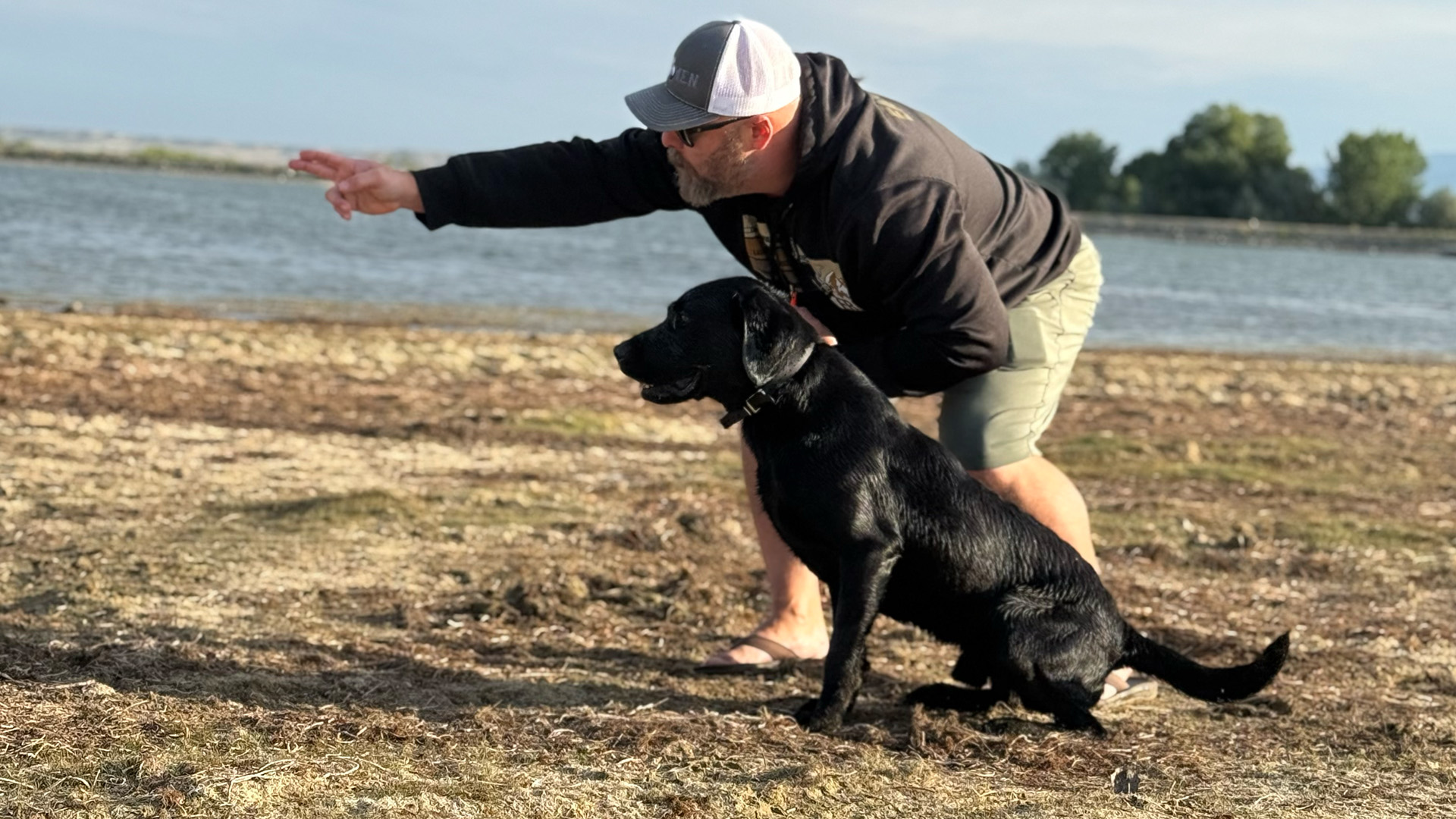
Here’s how it goes, say the command, “Whoa”. Then use the cord to physically stop the dog with a gentle upward pull of the check cord. Make sure not to let them take extra steps. “Whoa” means “Whoa.” If they do step, gently pick the dog up and place the dog back to where the command was given. It may take a few resets before they learn that’s the spot they need to stay. When I reset them back to where I gave the command, I try to keep the dog’s body as linear as possible. Meaning, I don’t two hand grab the dog by its chest and have it draped over my arms. I’ll place one hand under the dog’s chin where it meets the neck, then the other hand cupping the stomach at the base of the back legs. Pick them up, and set them back to where the command was given. Again, this might be on repeat for a while, don’t get frustrated. Pick them up, place them where the command was given and say it again, “Whoa”.
Repeat this action until the dog connects the command to the action and begins responding before the cord provides any input at all. When “Whoa” training, watch for the dog attempting to sit rather than holding a standing position. If they do try to sit, which almost every dog does, a light tap with the toe of your boot against the dog’s opposite rear knee brings it back to its feet without turning it into a big correction. Many times when you bend over to stand them up, using your hands, your dog will lose focus on the actual task, and start to come up to you. With the knee tapping method it keeps the dog focused on the object you are trying to achieve.
Consistency is everything at this stage. Short sessions built around quality repetitions produce better results than long sessions that lose the dog’s attention halfway through. Keep the work focused, end on a good rep, and come back the next training day, to do it again.
Retriever owners are comfortable with controlled bird introduction and the same logic applies with a pointing dog, with one important distinction that changes how you manage the early sessions. A pointing dog that catches a bird early in its development will spend countless attempts trying to catch another one. Now we have an issue that can take an enormous amount of time and repetitions to correct. It’s the one thing you don’t want to happen with training pointing dogs. Keep the dog on the short cord when birds are first introduced and maintain enough control that catching is simply not an option.
When a bird flushes, let the dog go, as long as the bird is flying strong enough to get away. Chasing a flushed bird is one of the best things that can happen during early development. It builds desire, it builds drive, and it keeps the dog hungry to find the next bird. The chase is not a problem to be corrected but a tool to be used. Later we can teach the dog to stop chasing, when it’s appropriate.
After bird introduction has been established and feels comfortable, then comes the introduction to gunfire. Gunfire introduction follows the same patient process regardless of breed, and the consequences of rushing it can be detrimental. A gun-shy dog is one of the hardest, time consuming problems in bird dog training and it almost always traces back to an introduction that happened too fast or too close. You will hear people talk about how some dogs are just born timid and gun-shy, but the truth is, if it has desire and instinct, you can train with that timidness. The process just needs to take more time and a lot of patients.
Here’s the best method I’ve used; after the point and flushing of a bird, wait until the dog is in full chase, completely absorbed and not thinking about anything other than running that bird down. Fire a single blank from a starter pistol at a reasonably long distance from your dog. Give it some time and distance before you pull the trigger, then observe.
Watch the reaction carefully. If your dog keeps running without acknowledging the shot, repeat the process a few more times. Then slowly start to shorten the distance between you and your dog as you fire a shot off. This should take multiple sessions.
Once you feel your dog is comfortable with a shot from a starter pistol, the next step is to transition from the starter pistol to a shotgun, followed by killing birds over your dog. Again, with
a much louder shotgun give your dog distance before firing off a shot, same process as with the pistol. Then progressively move the shot closer until you are at the range of being able to kill birds over them.
However, when introducing the starter pistol, if your dog pauses or shows any interest in the shot, put the gun away for a bit and keep running birds without any gunfire until your dog’s confidence fully rebuilds, and chase birds like it did before the shot. At that point reintroduce the shot from farther away and work back in gradually and slowly. Patience is key here as it is throughout the whole process.
Many people shy away from training their own pointing dog, when in reality it’s a simpler process than most would imagine, and many over think it. Yes, there are dogs and situations where it’s not that simple, but for the most part it’s within reach for most hunters. Be patient, never lose your cool or become heavy-handed, give the dog time to progress at its own pace, and be persistent. There’s no shame in hiring a trainer, but there is satisfaction in doing it on your own.