 Eastmans' Official Blog | Mule Deer, Antelope, Elk Hunting and Bowhunting Magazine | Eastmans' Hunting Journals
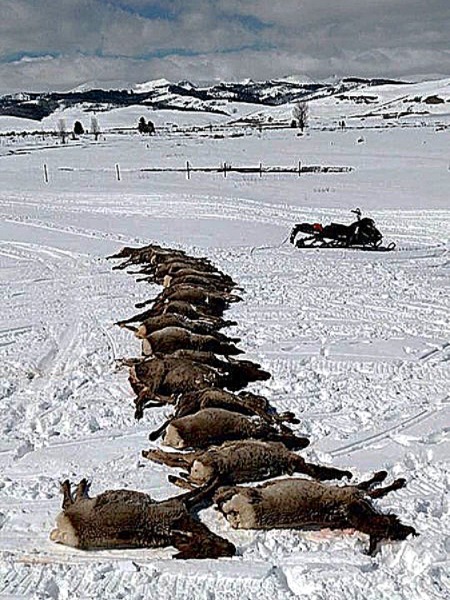
Wolves were introduced in Yellowstone Park in 1995 and were first noticed on a Wyoming Game and Fish (GF) feedground in 1999. That winter, four elk were killed on the Fish Creek Feedground in the Gros Ventre (GV) River drainage northeast of Jackson. By 2005 they had been observed on 16 of the 22 state operated feedgrounds. Since that time they have been documented on all feedgrounds located in Teton, Lincoln, and Sublette counties.
Assessing the effects of wolves on feedground elk and feedground management involves many factors. Overall, there are virtually no meaningful positive benefits. Some people and writers, who are out of touch with the reality of the situation, will preach that wolves are beneficial because they only kill weak and sick individuals, thus improving the overall health of the herds. Nothing could be farther from the truth with feedground elk.
Never have I observed wolves returning to a kill once they had their initial meal. Often, perfectly healthy elk are killed which can be regarded as “fun killing”. It is common for several elk to be killed in a night and not eaten. To further illustrate the point, a pack of nine wolves killed 19 elk one night on a feedground in the Upper Hoback. Perhaps, the situation is different where elk are not on feedgrounds, but that assessment of the situation is very shallow regarding feedground elk. Overall, there have not been any reports that indicate the killing of feedground elk adversely affects elk population numbers, although 73 elk, mostly calves, were killed one winter on a feedground. This illustrates that the potential of affecting elk populations does exist.
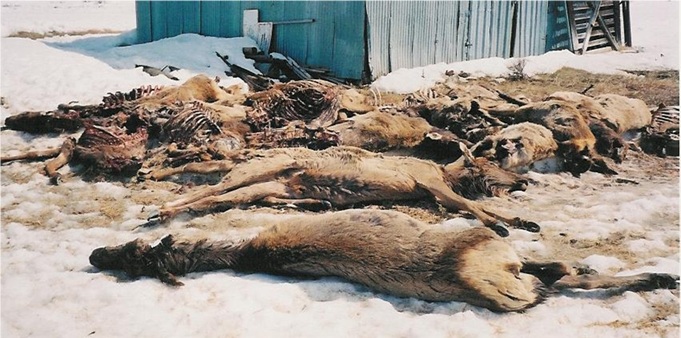
Wolves can have negative effects on several aspects of the management of feedground elk and elk management in general. Isolated situations occur periodically that cause temporary problems such as chasing elk off feedgrounds and on to private property. When this happens, the threat of transmitting disease to domestic livestock and damage to stored crops are of concern and require moving the elk back to the feedground.
The greatest negative effect of wolves can be seen in the Gros Ventre drainage and on Pinyon Ridge in the Upper Green River where wolves displace free ranging elk. The Gros Ventre drainage has long been the best winter range for elk in the areas served by feedgrounds. Approximately 100,000 acres have been designated by the U.S. Forest Service as big game winter range. Most of the livestock grazing has been removed, saving feed for wildlife. The Wyoming Game and Fish has spent a tremendous amount of money on habitat improvements. There are various estimates on the number of elk that could winter in the Gros Ventre. The Greater Yellowstone Coalition, using information from the Game and Fish, estimated more than 6,000 elk could winter there on existing forage. Pinyon Ridge has the capability to winter 100-300 free ranging elk.
The areas mentioned above are where elk can graze during the winter months and not attend feedgrounds. These “free ranging elk” are especially important for the Wyoming Game and Fish Department (GF). The GF has committed to combatting the potential detrimental efforts of Chronic Wasting Disease (CWD) by “low density feeding” on feedgrounds. This feeding strategy calls for feeding on several feed lines, thus spreading the elk while eating. It requires more feeding area than traditional feeding methods. Additionally, and more important, is encouraging elk to free range on native winter ranges, thus keeping them off feedgrounds. These are the primary strategies used by the GF to combat the potential deadly effects of CWD on feedground elk. However, the action of wolves is counterproductive to these efforts.
Elk harassed by wolves will form dense herds rather than remain scattered and they readily move to other areas to escape the predation. This occurs in the Gros Ventre as the elk readily move out of the drainage and onto the National Elk Refuge (NER) near Jackson, Wyoming. Estimates of free ranging elk in the Gros Ventre prior to the regular feeding of elk in 1954 varied from 2,310 to 9,128 elk. Ten years prior to the presence of wolves, feedground elk counts averaged 1,882 and free ranging elk averaged 1,694. Combined, this number is 3,576 elk which wintered in the Gros Ventre annually. Data from the past six years show only an average of 1,294 elk remain there each winter with just an average of 355 elk on native ranges.
The Fish Creek Feedground in the Gros Ventre offers the most desirable area for feeding elk and minimizing elk densities. It is a large area offering considerable opportunity for low density feeding. Prior to wolves, more elk attended this feedground than any other in the Gros Ventre. Elk attendance there averaged 700 elk per winter for the 10 years preceding the presence of wolves. The attendance in the most recent 10 years averaged only 178 elk with eight years of NO ATTENDENCE at all.
The current winter is very mild in the Gros Ventre with minimal snow cover. Given the lack of snow cover and the availability of forage there should be large numbers of elk wintering there. However, there are currently only about 100 elk free ranging in the Gros Ventre along with three packs of wolves. Go figure!
There is little doubt why vast amounts of native winter ranges go unused. In addition to the Gros Ventre situation, 100-300 elk previously wintered on Pinyon Ridge in the Upper Green River. They have now been chased in with the elk herd being fed at the Green River Lakes Feedground, increasing the density there, while the winter range sits idle.
There were originally three feedgrounds in the Gros Ventre. One was terminated before the winter of 2019-20, leaving only two (Patrol Cabin and Fish Creek). The closure of this feedground reduced part of the opportunity for low density feeding. Additionally, since wolf activity has basically precluded meaningful feeding at the Fish Creek Feedground, any elk that remain in the Gros Ventre are fed on the Patrol Cabin Feedground. This feedground has a small, limited feeding area and is much smaller than at Fish Creek. The recent 10 year average fed there is 982 elk. This number makes low density feeding virtually impossible.
Wolves also affect the NER effort to limit/eliminate elk feeding there. The NER employs pasture management strategies to improve forage production. Their goal is to provide enough feed so supplemental feeding may not be necessary. To accomplish this, the number of elk attending that feedground cannot exceed the amount of available forage, or otherwise, they will be fed. The additional elk from other feedgrounds, in this case, perhaps 2,000 to 3000 in some years from the Gros Ventre, complicates this effort.
The regular movement of elk from the Gros Ventre will likely result in a new learned behavior. It is believed that calf elk follow their mothers to a wintering area the first winter of their life. After that, they tend to return to this same wintering area. Several generations of elk calves have now wintered on the NER and will likely return there each winter, foregoing the native range.
An example of this learned behavior occurred in the Big Piney area. Elk were once fed at both the North Piney and Bench Corral feedgrounds. One year the North Piney elk were baited to the Bench Corral Feedground. Following this they essentially walked past the North Piney feedground en route to Bench Corral, even though they had been fed at North Piney for many years and hay was still offered there. The low elk attendance at the Fish Creek Feedground and the Gros Ventre in general may be other examples. Elk attendance at feedgrounds there and the utilization of vast amounts of native range may be a thing of the past or difficult to re-establish.
In addition to hindering efforts to enhance free ranging elk and reduce elk feeding, wolves have affected other aspects of feedground management in the Gros Ventre. Supplemental feeding patterns have been altered. The date of the initiation of feeding in the early winter prior to the introduction of wolves averaged January 9th. Feeding was delayed as long as possible in attempts to promote free ranging elk and minimize feeding costs. Today, given the action of wolves, hay is offered to elk much earlier in the winter. Currently, the average date when hay is first offered is November 20th. Much of this results from attempting to hold elk in the Gros Ventre rather than having them move on to the NER. When hay is offered, whether eaten or not, management costs increase via feeder salaries, etc.
Planning hay storage at the Gros Ventre feedgrounds has become very difficult. The feedgrounds in this area are remote and access during the winter months is limited to over-snow vehicles. This makes freighting hay to and between feedgrounds very difficult and costly. Given the remoteness of the Gros Ventre feedgrounds, having adequate amounts of hay prior to the beginning of the winter is important. Planning the amount of hay to have on hand at the beginning of the winter depends on the expected attendance of elk. To retain hay quality, it must be fed and replaced within a year or two. If fewer elk attend, hay sits unused. This is the situation at the Fish Creek Feedground where wolves readily displace the elk. For example, less than a total 10 tons has been fed at Fish Creek the past three years whereas the annual average per winter was 310 tons for the 10 years prior to the presence of wolves. The result is two large hay sheds, holding about 300 tons of hay, will sit for at least four years with quality decreasing each year. Since high quality hay is desired when attracting elk to feedgrounds, the value of the hay currently at Fish Creek is marginal and getting more so with each passing year.
These problems seem to be significant enough to address the management of wolves and their detrimental effect on elk management. In areas where wolf hunting is allowed year round, such as the Big Piney area and Upper Greys River, wolf interference with feedground operations is minimal. It is a different situation in areas where government regulations limit hunting. It seems ironic that the Game and Fish, which promotes and preaches the value of free ranging elk, sets wolf seasons that restrict their hunting for nine and a half months of the year, limits the number that can be killed, and draws hunt boundaries that provide protection for wolves. As well, the U.S. Forest Service prides itself on establishing this massive range for wintering wildlife by greatly reducing livestock numbers, restricting human presence, and placing travel restrictions for the area that makes hunting wolves nearly impossible during the winter months. With at least three wolf packs and about 20 wolves currently in the Gros Ventre, and it being nearly devoid of elk, it would seem that the few remaining moose would become a prime target for wolves and the struggling moose population will continue to decline. What about the Bighorn sheep that winter there? The bottom line is simply, do the Game and Fish and USFS want the Gros Ventre drainage to be a hunting ground for wolves or a winter range for big game?
They cannot have both!



As me being a hunter for the last 65 years, the addition of wolves into our hunting country is probably the worst and most dangerous thing that has ever happened to us. We will no longer have any good numbers of elk, deer, antelope ever again now or in the future. The futures looks very sad for outdoorsmen from now on.
Your only hope is to sss
It speaks volumes that a former WFGD employee sees what the remainder of the agency seems blind to. Or at least ignore. What a shame. I remember when GF was actually for hunters. Instead, it seems they are doing everything in their power to reduce hunting while protecting predators. WFGD has really gone downhill in recent years. JMO
Wyoming has lost an untold amount of national support and voice from nonresident hunters due personal attacks and outright abandonment. Years of severely limiting nonresident hunting tags, while dramatically increasing the cost of the availability of said nonresident tags, has lead nonresidents not to care what happens to the Wyoming wildlife. The result is the voice to elected representatives in defense of western hunting and conservation, especially Wyoming, has now fallen to just a whisper. Wyoming Fish and Game stated earlier this year, their budget is millions of dollars short because of the decline from tag and application revenues. Wyomians, this fight now belongs to you, and you alone, residents and the guide lobbyists. The amount of damage to wildlife will take many, many years to recover, with ever declining revenues. Good luck.
Delist wolves.
I have closely followed our wolf debacle here in Wyoming since ’95. As stated in this article, the ultimate purpose of the illegal wolf reintroduction is to eliminate all big game hunting, ranching and our western way of life. The problems described in the article here would mostly be solved by eliminating all controls on wolf hunting and opening up access so hunters could actually kill them all winter long.
No season, no quotas, no boundaries. It is the only common sense approach to this man-made disaster. The old timers got rid of them once before for many good reasons, we must do so yet again today.
AMEN John Wilson. Well said.
John Wilson is correct. 35 years ago I was in the Idaho fish and game department to look at the printout of draw tags, that’s how they did it before the internet for you kids. I heard am employee talking to the director telling him how Utah had published the winter kill numbers and how it had reduced there tag applications and maybe Idaho should not publish their winter kills. The whole conversation was about money and not the wildlife. This was before the Federal government shoved Wolves down our throats. The resulting reduced Elk numbers shortly after wolves were introduced into Idaho made me stop elk hunting because we hardly ever saw any in the southern part of the State. It has gotten better now that we can hunt some of them but wolves are not easy to find. Trapping is the best way to control wolves. I still hope to shoot one someday but I don’t buy a wolf tag because that would be supporting wolves in the state.